Eolux Is Selling Air Instead of Heat, and Quietly Competing With Your Repair Range
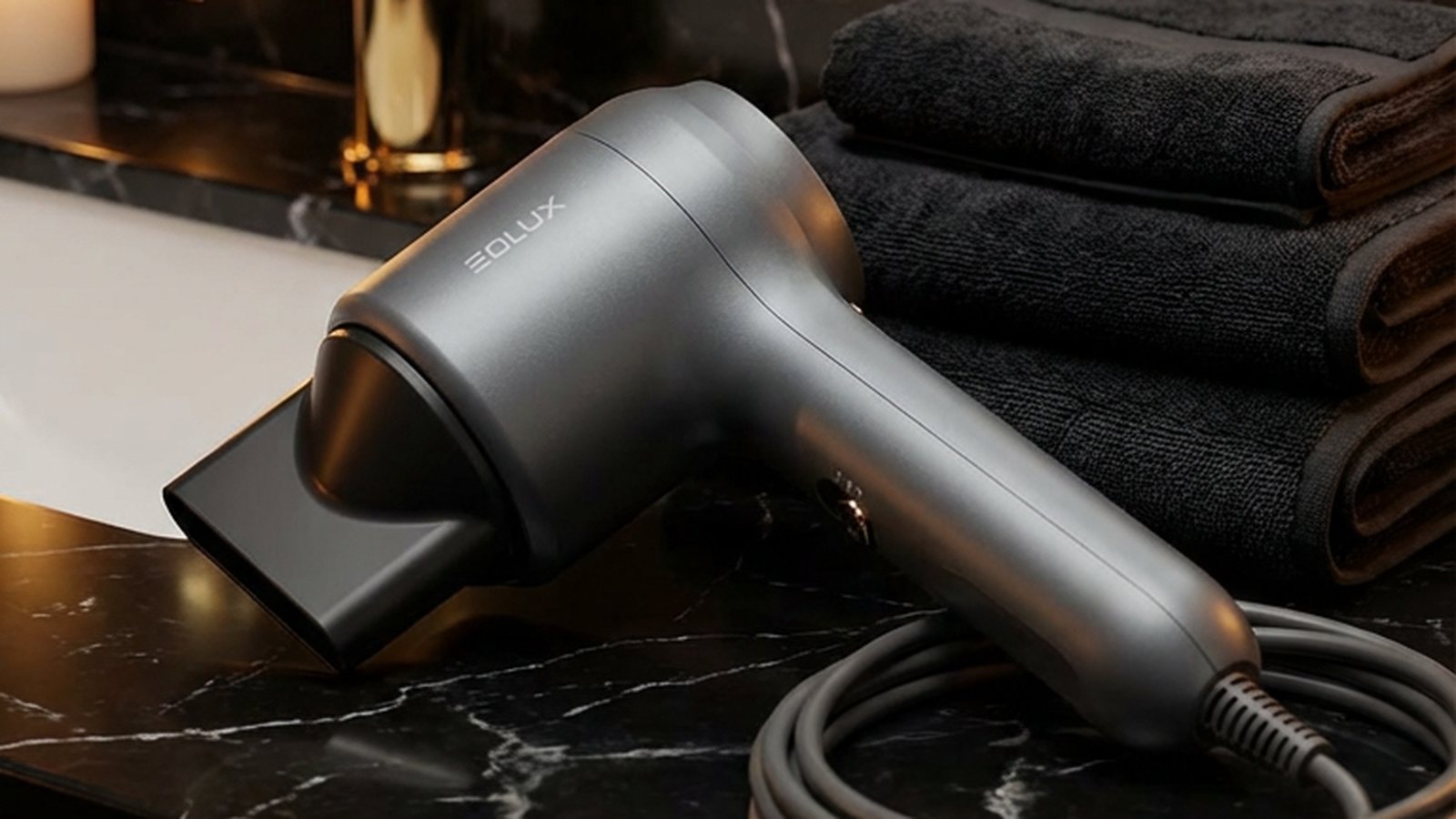
Hair devices are, in this magazine's observation, the fastest-moving part of the category, and they are quietly rewriting the haircare shelf beside them: heat becomes the damage, and the bond builder becomes the repair. A Madrid brand is arguing that the damage was never necessary in the first place.
Luna González founded Eolux, she told us at Beautyworld Middle East in October 2025, because she kept having to stop halfway through drying her own hair.
“I had an amazing, beautiful hairdryer,” she says, “but every time I would get out of the shower and blow dry my hair, I would have to stop. I would have to stop, put it on a YouTube video, a movie, because I was so exhausted of drying my hair.”
So she went to her father, who has more than forty years in technology and engineering, and asked whether it was possible to build something that simply worked faster. The answer became a hair care brand that sells no hair care, only hardware: ionic dryers across three lines, professional, retail and travel.
For anyone selling haircare rather than appliances, the shift underneath this matters more than the gadget. A category that reframes heat as the enemy changes the pitch of everything sitting next to it on the shelf. Bond builders, heat protectants and repair masks all take their reason to exist from damage the appliance is assumed to cause. A dryer claiming to cause less of it is competing, commercially, with those products as much as with other dryers.
The argument, and its honest limits
Eolux's technical position is narrow and stated plainly.
“Other hair dryers rely on heat for drying,” González says. “We rely on air and our technology, which is negative ions.” The claimed mechanism is that the ions break up the water molecule while sealing the hair, which she describes as leaving it “shiny, frizz-free”. The Spanish trade title Marrón y Blanco put numbers on it in April 2026: a brushless digital motor running to 100,000 rpm and an output the brand quotes at 200 million negative ions.
What distinguishes the pitch from most device marketing is what she says next.
We haven't invented anything groundbreaking. This is technology that's out there in the market. It's just other brands, I don't know for what reason, they choose not to use.
That is an unusually honest sentence for a fair floor, and it reframes the whole proposition. Eolux is not claiming novel science. It is claiming better execution of available science at a lower price than the brands that own the category's premium end. That is a harder story to tell on a shelf and a much easier one to defend in a claims review.
It is also worth being clear about what has not been established. Ionic drying has been on the market for years, and independent, published comparisons of ionic against conventional drying on measures like cuticle damage or moisture retention are thin. We could not find an independent evaluation of Eolux's own performance claims. That is not an accusation, it is the state of the evidence in a category where almost every device claim rests on manufacturer testing.
The professional route in
The more instructive part of the story for anyone launching a device is how González sequenced the market.
The brand was then roughly two years old, and had spent its entire first year selling only to professionals. “So we seeded different professionals all over the world. got back that feedback, re-engineer everything,” she says. “Maybe, oh, we want this, the cable, like this length, whatever. We modified that.” Only afterwards, from February 2025, did it open to consumers.
That order matters. Salon professionals are a brutal test environment and a credible reference, and the changes they asked for were unglamorous ones about cable length and handling rather than headline features. It also produced a benefit that turned out to matter most in salons. The quiet motor, a nice-to-have at home, is the professional range's strongest argument.
“If you have 10 different hairdressers, you're just working, everyone has it on, you're trying to talk to the client, the music,” she says. “So that's what comes into play the most in the professional side.”
For a brand deciding whether to launch into salon or retail first, that is the case for salon in one paragraph: the feedback is specific, the endorsement is portable, and the use case surfaces benefits a consumer focus group would never name.
What it cost
González is more candid about the difficulty than the outcome would suggest she needs to be.
“Coming in is difficult,” she says. “There's a small, like, boutique brand, and working with family is difficult, but it's possible.”
The engineering was not straightforward either. One of the products she calls a star is an air curler built as an attachment to the dryer rather than as a separate tool, which required getting a strong airflow through a double twist. “It's been hard,” she says, “but we managed to engineer that...”
The attachment decision is the commercially interesting one. Competing multi-stylers ask a customer to buy a second device or a full system. Eolux's version asks them to buy a head. For a retailer, that is a different margin structure and a different upgrade path, and for a salon it is one less thing to store.
Her account of the launch itself is disarmingly lucky, and she knows it. “We didn't know what was going to happen when we launched. Two days later, our world was made. We found amazing partners. We got distribution.” Asked what advice she would give, she offers something closer to a shrug than a strategy: “just to dream, because that's really happening.”
It is the least useful thing she says, and it is worth including precisely because it is honest. Not every founder's route is a repeatable method.
Where it goes next
Eolux's stated direction is away from dryers and towards a broader hair health range, still hardware rather than formulation. “Everything is based around hair wellness,” González says. “But we will also come out with very new... like technology and beauty tools that will help for the hair health. And we're trying to create things that don't exist, so it's going to take us a little bit.”
The travel range came first for that reason, framed as carrying the hair care routine rather than interrupting it. A compact dryer with the full motor and ionic system was shown at Beautyworld ahead of a wider market launch.
What to watch is whether the wellness framing survives contact with the evidence bar. Device brands are moving fast towards language that sounds like efficacy, and the regulatory attention on cosmetic claims has not yet fully arrived at appliances. Brands making hair health claims through hardware are, for now, held to a lower standard than brands making them through formulation. That gap is unlikely to stay open, and the brands that will handle its closing best are the ones already saying, as González does, exactly what they have not invented.
Founder of Eolux, a Madrid-based hair technology brand founded around 2023, open to consumers since 2025, and built with her father, an engineer with more than forty years in the field. The brand sells ionic hair dryers across professional, retail and travel ranges, plus an air curler attachment. Eolux sold to professionals for its first year before opening to consumers, and exhibited at Beautyworld Middle East.