Eleven Founders, One Floor. What Cannes Taught Us Last Autumn, And What We Are Watching In Dubai.
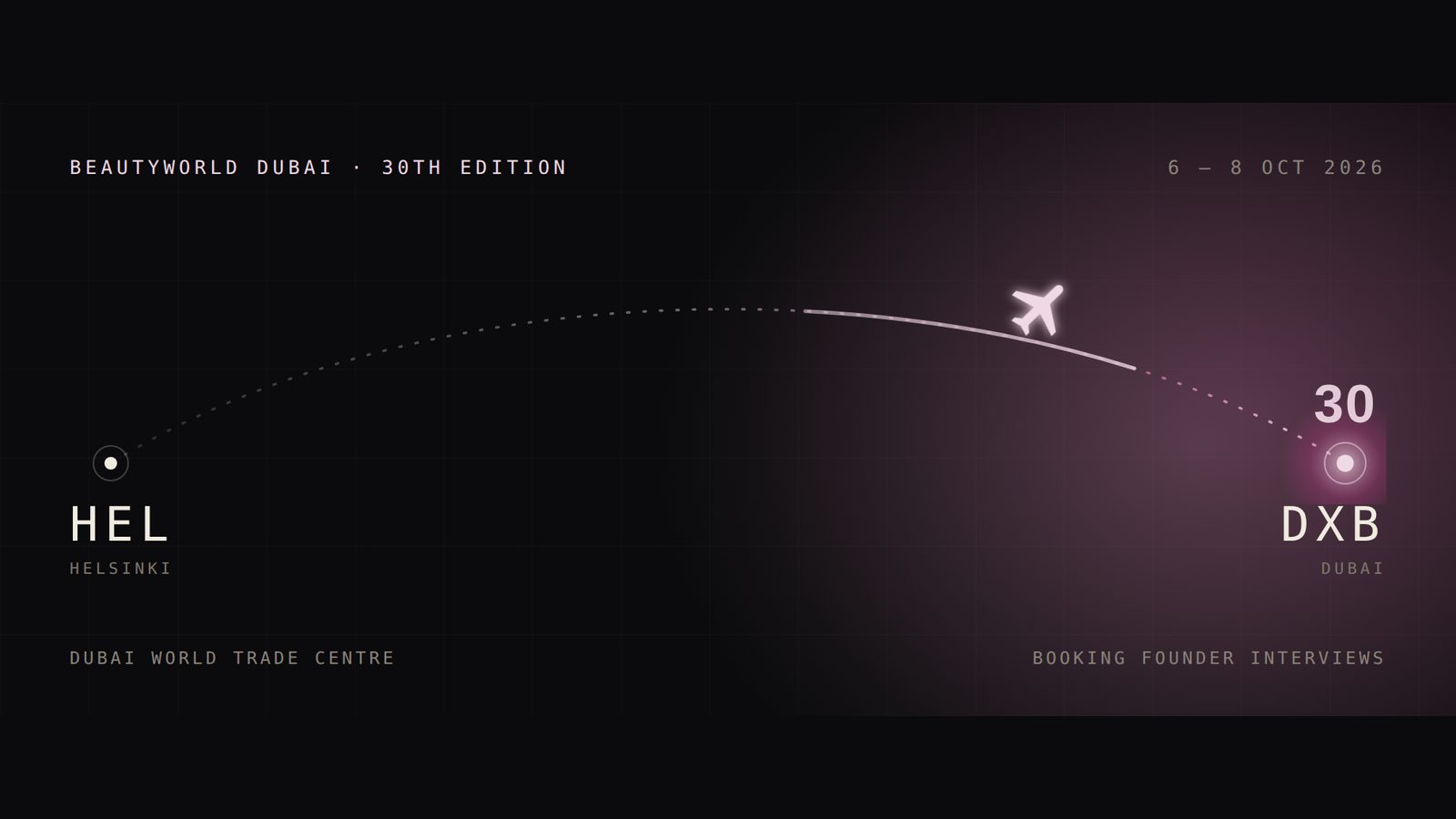
This piece draws on eleven founder interviews we recorded on the TFWA Cannes floor last autumn. Not one of them was a press conference. They were twenty-minute conversations on stands, between meetings, with people who had flown in to sell something and were willing to say what was actually working.
This October we are back in Dubai for Beautyworld, the first edition under its new name. The show has a new name, a new hall and a market underneath it that has changed shape over the year since. Here is what the eleven told us, what has moved since, and what we will be looking for. If you cannot get to Dubai this year, that last part is written for you.
First, the thing most coverage has skipped
It is not called Beautyworld Middle East any more. From this edition it is Beautyworld Dubai. The 30th edition runs from 6 to 8 October at the Dubai World Trade Centre, and the organiser expects more than 2,600 exhibitors and 85,000 visitors from 178 countries.
The rename is not decoration. Show Director Ravi Ramchandani put the argument plainly: "Dubai is no longer somewhere brands come to sell. It is where brands are being built." The numbers behind that are real. The GCC beauty market was worth about 14.3 billion dollars last year and is forecast to reach nearly 21 billion by 2030, with Saudi Arabia alone accounting for around 40 per cent of regional spending.
The detail that should stop any brand owner reading this: influencer-led beauty livestreams in the region convert at up to 30 per cent. Standard e-commerce runs at 2 to 3. That is not a marketing channel performing well. That is a different retail model, and most European brands are still treating it as a campaign line item.
What eleven founders actually said
The clearest pattern from last autumn was not a product trend. It was a set of decisions about where a brand draws its lines.
On AI, nobody we spoke to was undecided, and almost nobody agreed. Deniz Sezer Günay of Atelier Rebul described it as "basically another colleague within the company". Zakir Husain of Swiss Image drew the line at the idea rather than the asset: his brand's use is "more about arriving at the thought", and "we are looking at enhancing what an artist can do". Clara Giusta of PATYKA was more careful again, using AI for backgrounds and caption inspiration and never for models, and disarmingly frank about the scale of it: "the process is more internal than external", and "we don't have AI software".
Olivia Jo of CHOUCHOU TOKYO was the outlier, and deliberately so. "I think AI is a little bit far away from us," she said. "We are more like close to human nature because we are like very experienced based beauty brand." For a brand built on in-person treatment, distance from the technology was a positioning choice rather than a gap.
That spread turned out to be the story, and it has aged well. Ten months later the EU AI Act's transparency rules apply, and the brands that had already decided where their line sat are the ones that did not spend August scrambling.
On fragrance, the useful insight came from Abunasar Merchant of RIIFS Parfums, a fourth-generation house selling niche and mass worldwide. His point was about demand quality rather than demand volume. Loyal local buyers, he said, "have enough time to get the details" and buy after "thinking a lot and then they go". A shopper who researches before purchasing is a shopper a serious house can keep. Impulse footfall is not.
Sezer Günay made the related structural point: Atelier Rebul arrives as "a heritage brand, but at the same time contemporary", now in 21 countries and 1,000 luxury sales points. In a crowded aisle a credible past is a moat that a new label cannot buy.
What has changed underneath the show
Three things have moved since last autumn, and none of them appear in the show's own materials.
Fragrance has been given its own hall. Za'abeel Hall 7, more than 220 exhibitors across 19,000 square metres. That is a serious commitment to the category that already accounts for roughly 80 per cent of top brand value in the region, worth about 1.3 billion dollars in 2025.
Fragrance supply chains have also had their hardest year in a decade. Ingredient sourcing has been disrupted, some houses have moved to air freight, and launches have been pushed back. Regional preference for 25 to 30 per cent concentrations against a global norm of about 20 means every cost increase lands harder here than elsewhere.
And the region's logistics have been reshaped. Jebel Ali handled 374,000 TEU in the second quarter of this year, against 3.8 million in the same quarter of 2025. Dubai airport carried 31.5 million passengers in the first half, down 31 per cent year on year, with only about 50 of 90 international airlines flying at the end of June. Airspace has been open since 3 May and traffic is recovering, but the network is thinner than it was.
Expanding the fragrance hall in the year fragrance logistics got hardest is either confidence or bad timing. We intend to find out which.
What we are looking for, depending on who you are
If you are a brand owner, the question is which halls the buyers actually walk. A 22-hall show is not one show, and a first stand costs more in attention than in money. We will be counting who is where.
If you are a distributor or an importer, the interesting stands are the new regional houses. Al Majed for Oud from Saudi and Gissah from Kuwait are both debuting. The question we will put to them is a supply one: what can they actually ship, at volume, with the Strait of Hormuz in the state it is in.
If you are a retailer, watch the concentration question. A 25 to 30 per cent formulation is a different cost base and a different shelf life, not just a different smell, and it is spreading outward from this region into global formulations.
And if you are not going at all, which is most of the people reading this, that is the part we are there for. We will be on the floor for all three days, recording founder interviews the way we did in Cannes. Every piece of reporting from those three days will be published here.
One thing we will be asking
Messe Frankfurt postponed Beautyworld Riyadh from May this year to June 2027, citing the regional environment. It is running Beautyworld Dubai on the dates it set in November 2025, before any of this began.
Both decisions may well be right. Nobody has asked the organiser to explain the difference, and we will.
Reported from the TFWA World Exhibition and Conference in Cannes, autumn 2025. Quotations are from interviews recorded on the show floor there. The five founders quoted here were previously published in this magazine on 31 July 2026. Market and logistics figures are sourced to the 2026 Middle East Beauty Market Report, Euromonitor, Seatrade Maritime and Dubai Airports, checked on 28 August 2026.